Why Deep Linking Is Becoming Core Mobile Infrastructure?
Deep linking is no longer just a marketing tool. Mobile deep linking now supports navigation, onboarding, authentication, personalization, and seamless user journeys, making it an important part of modern app infrastructure.
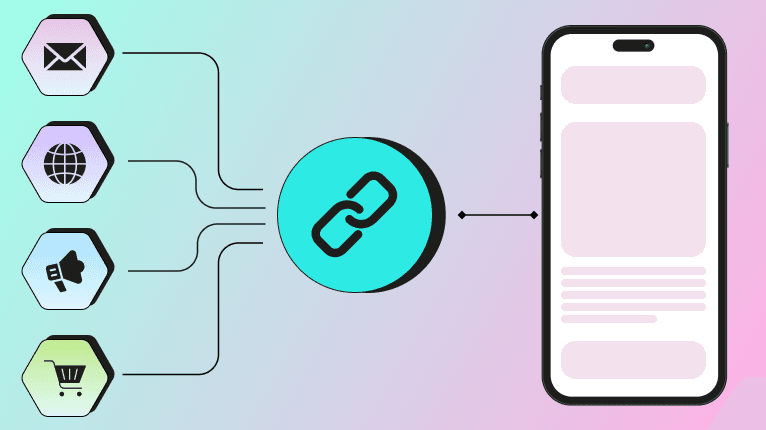
Most people still think of deep linking as a marketing tool for app installs and campaign tracking. That made sense a few years ago, but today's mobile apps tell a different story. When a link sends users to the wrong screen, it's a product problem. Like electricity at home, you rarely think about deep linking until it stops working. In this article, we'll explore why deep linking has evolved into core mobile infrastructure and why engineering teams should start treating it that way.
Deep Linking Is No Longer a Marketing Feature—It's Infrastructure
Deep linking is no longer just a marketing capability. It has quietly become the plumbing behind modern mobile experiences. While marketing teams first adopted it for campaign attribution and user acquisition, that early use case shaped the industry's perception more than the technology itself. Today, deep linking underpins mobile app architecture, navigation, onboarding, authentication, personalization, deferred deep linking, and seamless experiences across apps and digital touchpoints. Teams looking to implement these capabilities without building their own routing infrastructure can sign up with a dedicated deep linking platform.
The strongest evidence is the role deep linking now plays throughout the mobile application lifecycle.
Deep linking powers far more than marketing campaigns:
- Preserves user context across sessions
- Powers personalized onboarding
- Secures authentication and password resets
- Enables direct in-app navigation
- Connects offline experiences through QR codes
- Supports AI-driven experiences
These aren't marketing tricks and rather they're the mechanics that keep mobile apps running smoothly. Like plumbing, deep linking is easy to ignore until something breaks. Then it's suddenly everyone's problem.
When a technology becomes essential to how an application functions, it stops being a feature and becomes infrastructure. Deep linking has reached that stage, becoming the routing layer behind today's mobile applications. Marketing is now just one consumer of a capability that powers the entire product experience.
Evidence 1
When users open a Spotify playlist, join a Slack workspace, reset a banking password, continue an Uber ride, or scan a QR code to complete a payment, they're using deep linking as part of the product and not as part of a marketing campaign.
Spotify spent several years rebuilding its deep linking and attribution architecture after it became clear that deep linking had grown beyond marketing campaigns. Today, it supports everything from shared playlists to navigation and attribution, making it a core part of the product rather than a standalone marketing capability
The Mobile Shift Marketers Need to Understand
The mobile ecosystem has changed, and so has deep linking. A user journey no longer begins and ends inside a single app. Every new touchpoint introduces another routing decision, making deep linking less about opening an app and more about guiding users to the right destination. Think of it as the GPS for modern mobile experiences. It doesn't just point users in the right direction but remembers where they're headed.
The evidence is everywhere.
Deep links:
- Connect users across channels
- Route users to specific in-app experiences
- Bridge offline interactions
- Enable AI-driven workflows
These are proof that modern user journeys are connected.
Deep linking didn't evolve because marketing changed. It evolved because user journeys did. Today, apart from just opening apps, it orchestrates seamless experiences across the entire mobile ecosystem.
Evidence 2
Marketing campaigns used to mark the beginning of the mobile journey. A user might discover a product through Google, save it from an email, share it on WhatsApp, complete the purchase in the app and later track the order from a push notification. Every step depends on deep linking to preserve context and move users seamlessly between touchpoints.
Google now supports app deep links directly from Search, allowing users to move from a search result to the exact screen inside an app. This reflects how modern user journeys span web and mobile rather than beginning and ending inside a single application.
If Engineering Doesn't Own Deep Linking, Users Pay the Price
Deep linking is no longer a growth feature managed by marketing and it's part of the product. Users don't care which team owns the problem. They only know the app didn't do what it promised. As deep linking becomes central to how people access and navigate mobile apps, engineering teams must treat it as core application architecture.
The consequences become clear when deep linking isn't engineered properly. A broken onboarding flow can lose the user's original context after installation, sending them to a generic sign-up screen instead of the promised destination. It's a bit like handing someone a front-row ticket and then pointing them toward the parking lot.
When deep linking breaks, the impact spreads quickly:
- Lost onboarding context
- Wrong destinations
- Missing fallback handling
- Duplicate API calls
- Broken analytics
- Poor attribution
Incorrect routing, missing fallback logic, and duplicate API calls create broken journeys, while inaccurate routing weakens analytics and attribution. What begins as a routing issue quickly becomes a product issue.
Every tap is a promise. When deep linking works, users never think about it. When it doesn't, they remember the app and not the technology behind it. That's why treating deep linking as product infrastructure is no longer optional.
💡Popular insight
Users don't experience organizational charts, they experience products. To them, every broken deep link is simply a broken product.
Treating Deep Linking as a Marketing Tool Creates Technical Debt
Deep linking worked well as a marketing-owned feature when its primary purpose was driving app installs and campaign attribution. But today's mobile ecosystem has outgrown that model. As deep links now power onboarding, navigation, and core product experiences, managing them as campaign assets creates fragmented implementations, duplicated logic, inconsistent analytics, broken user journeys, higher maintenance costs, and slower product development. You wouldn't build your app's navigation in a spreadsheet, so why manage its entry points like a campaign asset?
Technical debt builds as teams introduce:
- Separate routing systems
- Multiple deep-link SDKs
- Overlapping analytics layers
- Fragmented ownership
- Constant routing updates
Eventually, you're spending almost as much time fixing the roads as building new destinations.
The solution is to treat deep linking as shared engineering infrastructure with centralized routing, consistent governance, and a single source of truth. Choosing a platform with transparent deep linking pricing can reduce maintenance costs while helping engineering teams scale without accumulating technical debt. When engineering owns the architecture and marketing builds on top of it, teams deliver more reliable user journeys without accumulating technical debt.
💡Popular insight
Imagine every team building its own login system. Deep linking works the same way - shared infrastructure scales, while DIY routing creates endless maintenance.
The Next Generation of Mobile Apps Will Be Built on a Dedicated Linking Layer
The next generation of mobile applications is evolving from isolated apps into connected ecosystems powered by artificial intelligence, agentic workflows, and edge computing. This shift requires a dedicated linking layer that enables seamless continuity across apps, devices, and platforms. In a connected world, users expect apps to remember where they came from. As AI-driven experiences, super apps, and omnichannel engagement become the norm, intelligent routing will be as fundamental as APIs, authentication, and cloud infrastructure.
Deep linking won't just connect users to apps and will connect every step of their journey. Organizations that treat it as core infrastructure today will build faster, scale smarter, and deliver the seamless experiences users expect tomorrow. Because in the future, the smartest app won't be the one with the most features. Rather, it'll be the one that never asks users to start over.
💡Popular insight
Yesterday it was APIs. Then authentication. Then cloud. Tomorrow, it'll be intelligent routing. Every generation of software gets its own essential infrastructure.
Jonas
Developer